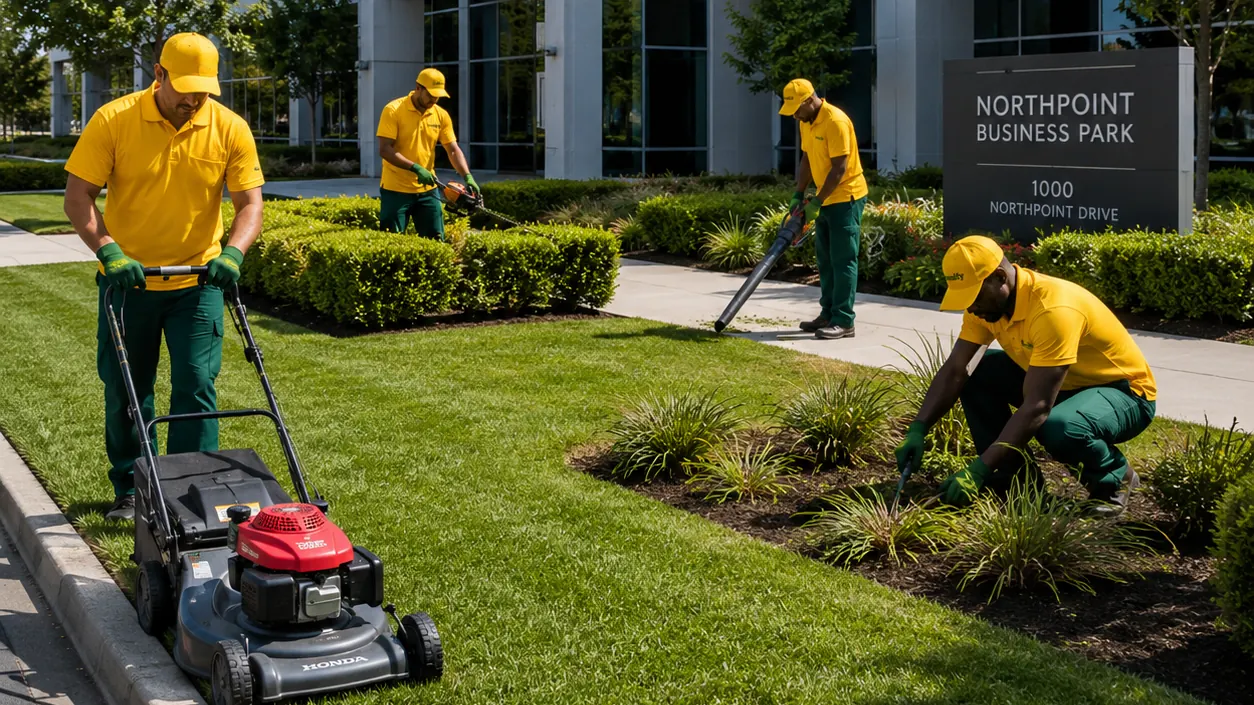
Mowing & edgingPer visit, on a planFrom $35
Ride-on mowingQuarter acre and upFrom $65
Weed & feed programmePer application, 4–6 a yearFrom $85

Everything that happens to the grass itself — cutting it, feeding it, fixing it and replacing it. Tell us what you are seeing and we’ll tell you which of the five you actually need.
Not sure which service? Describe it and we’ll work it out.
Two of them run on a schedule. Three are jobs you book when the lawn needs them. All five can happen on the same visit.
Starting points, not quotes. Section size, access, slope and edge length all move them — which is why we look before we price.
Green waste disposal is already included in the prices above. On a standard section we can usually price mowing from two photos without visiting. Dethatching and new lawns are confirmed after seeing the ground, because on those the ground is the job.
Most people arrive wanting one of three things. Pick the closest and it will point you at the right place to start.
Then you want a schedule, not a service. Pick a frequency, we price your actual section, and the rest looks after itself — including stepping up over summer and back through winter.
Start with mowing plansMowing alone will not fix colour, thinning, moss or a spongy surface — those are soil and thatch problems. Work out the symptom in the next section, then treat the cause.
Go to the diagnosticNew build, a section that has been dug up, or grass that has given up entirely. This starts with the ground underneath, not with turf — and doing it in that order is what makes it last.
Start with new lawn installNobody rings up asking for dethatching. They ring up because the lawn feels spongy. Here is how the two connect.
A thatch layer — dead runners and stems built up between the green blades and the soil. Kikuyu produces it faster than almost any other grass, and once it passes about 2cm water and feed stop reaching the roots.
Compaction. Turf laid straight onto a builder’s skim of topsoil over pasture that carried machinery for a year. Roots stay in the top few centimetres, and the first properly dry spell finds them out. Watering more does not help, because the water cannot get down either.
Coastal dune sand. It drains in minutes and holds almost no nutrient, so a single heavy feed leaches straight past the roots. What works here is lighter, more frequent feeding and a higher mowing height so the leaf shades its own soil.
Damp, shade and compaction together — and moss is the symptom, not the problem. Killing it just leaves bare patches for it to reclaim. Getting water into the soil instead of sitting on a spongy layer is what actually shifts it.
Scalping. Too much leaf coming off in one pass, which strips the green and exposes the pale stems underneath. Almost always caused by leaving it too long between cuts rather than by the mower — see the one-third rule below.
Kikuyu doing exactly what kikuyu does. It spreads by runners above ground and rhizomes below, and in peak growth a runner can extend several centimetres in a day. It will not stop on its own — it needs a cut edge maintained.
It dominates the warm coastal Bay of Plenty, and it behaves nothing like the fescue and ryegrass lawns most advice is written for.
Never remove more than a third of the leaf blade in a single cut. It sounds like fussy advice and it is actually the single most useful thing to know about a kikuyu lawn, because it quietly explains almost everything in the section above.
Leave it three weeks in December and you cannot get back to a tidy height in one pass without breaking the rule — so it yellows, the clippings are too bulky to mulch back in, and the plant puts its energy into recovery instead of growth. Do that a few times and you get thinning, then thatch, then moss in the shady corners.
Which is why frequency matters more than anything else you can do. A lawn cut a little and often looks better than the same lawn cut hard and rarely, and it costs less per visit too.
Several common hose-on weed-and-feed products and broadleaf treatments are not suitable for kikuyu and can damage it — Yates specifically advise against using their Weed ’n’ Feed hose-on or Turfix on kikuyu lawns. They sit on the shelf next to everything else with no warning on the front. If you are treating it yourself, check the label says kikuyu is safe before it goes anywhere near the lawn.
One more local thing. Kikuyu goes semi-dormant and browns off over winter, which alarms people who have moved here from cooler parts of the country. It is not dead and it does not need rescuing — it comes back hard in spring. What it does still need is the occasional winter cut, because the coastal Bay of Plenty stays mild enough that growth never fully stops. A mild winter is not the same as no winter.
Doing the right job in the wrong season is most of what goes wrong with a lawn. This is the order that works here.
Not now: dethatching — too much recovery needed before summer.
Not now: renovation of any kind. It will not recover in the heat.
If you do one thing a year, do this one.
Not now: heavy feeding, or panicking about the colour.
Ours had gone spongy and half moss and I assumed it needed replacing. They dethatched it in April, overseeded, and by November it was the best lawn on the street. Cost a fraction of what a new lawn would have.
All five services run across Tauranga and the wider Bay of Plenty. Each area has its own page with the local ground conditions and what they mean for a lawn.
Ground varies enormously across that list — coastal dune sand at Pāpāmoa, heavy river flat at Bethlehem, deep volcanic ash at Te Puke, compacted new-build fill at Pyes Pā. It is the same five services, adjusted for what is under your grass.
The ones we get asked most across all five services.
Push your fingers down through the grass to the soil. If there is a spongy brown layer more than about 2cm thick between the green blades and the ground, that is thatch and it is time. The other giveaway is the feel — a thatchy lawn is springy underfoot, like walking on carpet underlay, and it stays wet for ages after rain because water cannot get through. Most lawns here want it about once a year.
Almost certainly not. Warm-season grasses go semi-dormant when it cools down, which shows as browning or a bleached look, and they come back hard in spring on their own. What the lawn does still need is the occasional cut, because the coastal Bay of Plenty stays mild enough that growth never fully stops — skipping three months entirely leaves you fighting thatch and patchiness in September.
Roughly 2.5 to 5cm for most lawns here, toward the higher end through summer. The more important rule is never taking off more than a third of the leaf blade in one pass. Cutting short exposes pale stems, stresses the plant, and lets the soil dry out and weeds in. On sandy coastal sections, height is the cheapest drought protection there is.
Check the label very carefully first. Some common hose-on weed-and-feed and broadleaf products are not suitable for every grass type and can damage the lawn, and the warning is not always on the front. If you are not certain what grass you have, that is a good reason to let someone else handle the chemistry.
Managed rather than stopped. Fast-growing lawns spread by runners above and below ground, and at peak growth they move quickly into beds. What keeps them in bounds is a maintained cut edge every visit, and mulch with weed mat in the beds they are heading for.
Fix it, in most cases. A lawn that is thatchy, mossy or thin usually has perfectly good grass underneath and responds to dethatching, feeding and overseeding for a fraction of a replacement. Replacement genuinely makes sense in two situations: when the ground underneath is compacted so badly that nothing will root into it, and when there is more weed than grass left. We will tell you honestly which you have — there is no sense selling you a new lawn onto ground that will kill it too.
They are mulched back into the lawn by default. Finely chopped they break down within a few hours on a regularly mown section and feed the soil for free. When there is too much to mulch — an overgrown first cut, or a lawn with thatch already building — we catch and remove them instead, and that disposal is already in your price. Prefer them collected every time? Just say, and we will.
Mowing starts from $35 a visit, and ride-on work from $65. Green waste disposal is already in the quoted figure.
