

Beds that have been planted for years — the job is keeping shape, weeding before it takes over, and deadheading, not deciding what goes where.
Garden Maintenance
Te Puke
Garden Maintenance in Te Puke
An established town garden and a newer property with shelter-belt planting along an orchard boundary need different attention — one wants tidying and control, the other wants establishing and shaping. We run both on a schedule that suits the garden, not a generic round.
- Weeding, pruning, edging, tidy-up
- Regular visits or one-off tidy
- Green waste taken away
- No lock-in contract
Tell us about your garden
A rough size and what’s bothering you most helps us scope the visit.
Fully insured
Same gardener where possible
Green waste included
Pause any time
Two kinds of garden, two kinds of visit
What “maintenance” means changes with the property.
Younger hedges and windbreak planting on orchard-fringe properties need formative pruning and mulching to establish well, more than a quick weed.
Many Te Puke properties have an established front garden and newer planting further back — we scope each part separately rather than treating the whole section the same.
2–4wksTypical visit interval
100%Green waste removed
FixedNo surprise add-ons
0lock-inPause or stop any time
Why an established garden and a new one drift differently
Same neglect, different failure mode.
Established, left too long
Overgrown, weed-choked
New planting, left too long
Leggy, poorly shaped
An established Te Puke town garden left unattended for a season doesn’t die — it goes the other way. Weeds get ahead of the beds, self-seeding plants spread past their spot, and what was tidy structure turns into a green blur that takes real hours to bring back.
Newer shelter-belt or boundary planting on an orchard-fringe property fails differently. Without early formative pruning it grows leggy and uneven rather than filling in as a hedge or screen — a shape problem more than a weed problem, and harder to correct later than to get right early.
We scope the visit to which of those two problems your garden actually has. An established bed gets weeded and controlled; new planting gets shaped while it’s still forming.
Neglect shows up differently depending on the garden’s age. Established beds go to weed; new planting goes to leg. We treat them differently.
What a maintenance visit includes
Scoped to the garden, every time.
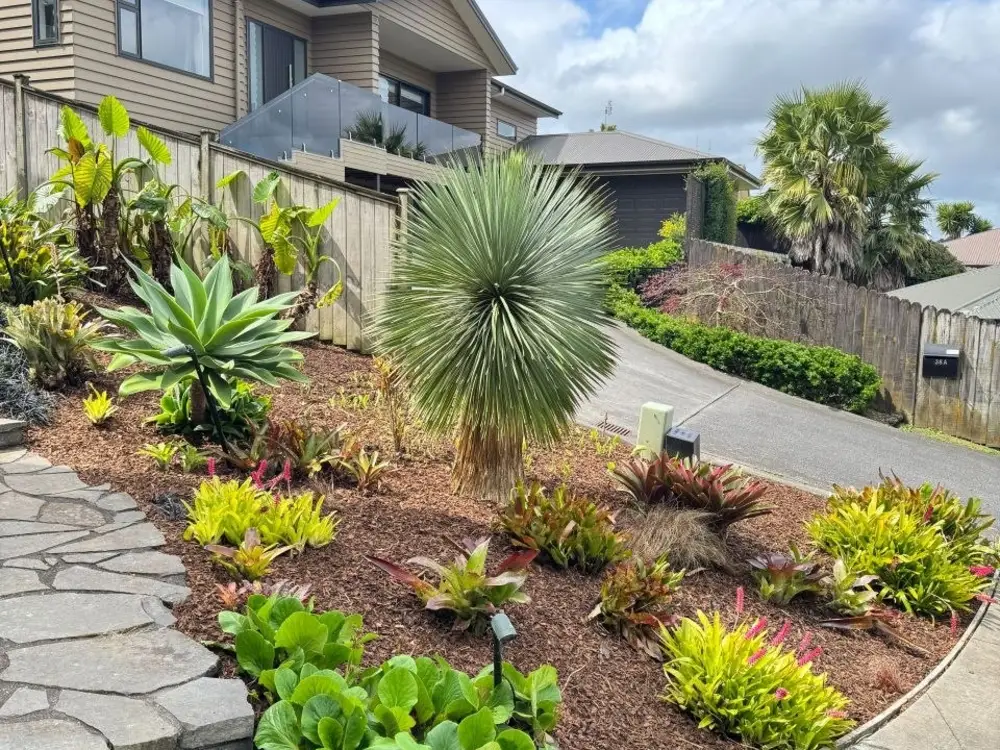
The same visit, every round — weeded, pruned, edged, cleared.
- 01Assess the bedsQuick walk to spot what needs attention this round.
- 02Weed and deadheadBeds cleared, spent flowers removed to keep things tidy.
- 03Prune and shapeFormative or maintenance pruning depending on plant age.
- 04Edge garden bordersClean line kept between garden bed and lawn.
- 05Clear and removeAll green waste bagged and taken away, nothing left behind.
On site45–90 mins, size dependent
Green wasteAlways removed
We’ll flag anything bigger than a routine visit before starting. A garden that’s gone well past its last tidy sometimes needs a first catch-up visit priced separately from the ongoing rate.
Established beds versus new planting — Te Puke’s two gardens
Both common here, and neither gets the other’s treatment.
Te Puke’s mix of a settled town centre and newer streets pushing out toward the orchards means we see both garden types every week — mature beds that just need holding in shape, and young shelter planting that’s still finding its shape. We scope maintenance to which one we’re looking at.
Established town section
Where control is the job
- Established beds with years of growth already in place
- Weeding and deadheading are the main recurring task
- Structure is set — the job is holding it, not creating it
- Usually a straightforward, predictable visit each round
Orchard-fringe property
Where establishing is the job
- Younger shelter-belt or boundary planting still filling in
- Formative pruning matters more than weeding at this stage
- Mulching helps new planting establish through dry spells
- Visit length varies more as the garden develops
Tell us which kind of garden you’ve got when you enquire. We’ll scope the first visit accordingly rather than quoting a generic rate that doesn’t fit either.
What it costs
Fixed once we’ve looked, starting from $65 per visit. Green waste is already in it.
-
Small town garden
Regular tidy, established beds
From $65 -
Standard garden, regular visits
Fortnightly or monthly round
$65–$120 -
Larger or orchard-fringe property
Bigger beds or shelter planting
Quoted -
One-off catch-up tidy
Garden left a while
Quoted
What moves it
Garden sizeBed area more than section size
Visit frequencyRegular rounds cost less per visit
OvergrowthA first catch-up takes longer, priced separately
Pruning needsEstablished shaping vs formative work
Regular visits are cheaper per visit than one-offs. A garden kept on a schedule rarely needs an expensive catch-up.
Best time of year for garden work
Spring growth and autumn tidy are the two busy windows.
JanFebMarAprMayJun
JulAugSepOctNovDec
Frequency key
Peak seasonSteady maintenance
Spring is when gardens get away on people fastest. A regular round through the growing season keeps it from ever needing a big catch-up.
We’d let the front beds go for a couple of years after moving in. First visit was a proper catch-up, priced fairly and explained up front, and now it’s a quick fortnightly tidy that barely takes any time.
What people ask us
Mostly about the job rather than about us, which is how it should be.
Booking & scheduling
01Is garden maintenance in Te Puke one-off or only regular contracts?
Both. A lot of clients start with a one-off catch-up and move to regular visits once the garden’s back under control, but there’s no obligation either way.
02What’s included in a regular garden maintenance visit in Te Puke?
Weeding, deadheading, edging garden borders, and pruning as needed, with all green waste removed. It’s scoped to what the garden needs that round.
03How is garden maintenance in Te Puke priced if garden size varies?
On bed area and how overgrown it is, not just section size. A small, well-kept bed costs less than a large or neglected one.
04Can garden maintenance in Te Puke shape new hedge or shelter planting?
Yes — formative pruning on younger planting is part of what we do, and getting it right early makes a real difference to how it fills in.
Pricing & property
05Do I need to be home for garden maintenance in Te Puke?
No, most regular clients aren’t. We just need clear access to the garden.
06What happens to green waste from garden maintenance in Te Puke?
Bagged and removed the same visit, included in the price.
07Can I pause garden maintenance in Te Puke over a slow season?
Yes, pause or adjust frequency any time — there’s no lock-in contract.
08How much does garden maintenance in Te Puke cost?
Most Te Puke gardens start from around $65 a visit. The exact price depends on garden size, how overgrown it is, and what needs doing.
While we’re there
Most people add one or two of these, since we’re already on the property.
VIEW ALL
All Te Puke services
The full twelve, and what the Kiwifruit Capital does to each.
07
Tree & Hedge Trimming
Species checked first, shelter belts included.
08
Stump Grinding
Compact grinders for sections a full-size machine can’t reach.
09
Shrubs & Rubbish Removal
Roots out properly, waste sorted into the right stream.
10
Mulching, Bark & Weed Mat
Roughly halves the weeding on every visit after it.
11
Rental & Section Clean-Ups
Dated before and after photos, itemised invoice.
12
Commercial Grounds Maintenance
Scheduled visits, single point of contact, H&S done properly.
Garden Maintenance in other areas
