

Wider stumps take longer to grind and produce more mulch to deal with afterward.
Stump Grinding
Tauriko
Stump Grinding in Tauriko
A stump left in the ground doesn’t just sit there — it keeps sending up suckers, rots slowly into a soft patch, and gets in the way of any new planting or lawn work planned around it. Tauriko’s established sections often have old stumps left behind from tree work done years ago, while new-build sections sometimes turn up leftover stumps from site clearing that never got ground out properly. Grinding takes it below the surface so the ground can actually be used again.
From $95per stump
Fixed price agreed before we start — nothing added after.
- Ground to below root-flare level
- Mulch left or removed, your choice
- Utility lines checked before grinding
- No lock-in, cancel any time
How big is the stump, roughly?
A rough diameter and how many stumps helps us quote accurately.
Fully insured
Ground below root-flare level
Utility lines checked first
Pause any time
Three things decide how a stump grind is priced
Diameter is the starting point, not the whole story.
Some species have shallow, wide root flares that need extra grinding passes to get properly below ground level.
Tight access or nearby underground services both slow the job and change how the grinder can be positioned.
250mmTypical grind depth below surface
30–60minTime per standard stump
$95fromPer stump, small
48hrNotice needed for a utility check
Why grinding beats digging a stump out
Two ways to deal with a stump, one of them tears up the lawn to do it.
Dig and pullLarge hole, damaged lawn
Grind below surfaceMinimal disturbance, ready to fill
Digging a stump out means excavating around the entire root ball, which on an established tree can mean a hole a metre or more wide and just as deep. That’s a lot of disturbed lawn for one stump.
Grinding works from the top down, chewing the stump and root flare into mulch below ground level without needing to expose or pull the roots at all.
It’s faster, cleaner, and leaves the ground ready to fill. The resulting mulch and a bit of topsoil is usually all that’s needed to level the spot for new lawn or planting.
Deeper structural roots are left in the ground either way — they break down naturally over time and don’t stop new growth going in on top.
Grinding leaves a hole you can fill, not a hole you have to fill in. That difference is most of why it’s the standard method now.
What a stump grinding visit includes
Checked, ground, and cleared, usually in one visit.
Check for servicesUnderground lines marked or confirmed clear.
Confirm grind depthSet below root-flare level for filling.
Grind the stumpGround down in overlapping passes.
Clear surface debrisLoose mulch and chips removed or piled.
Level and adviseHole levelled, fill or planting advice given.
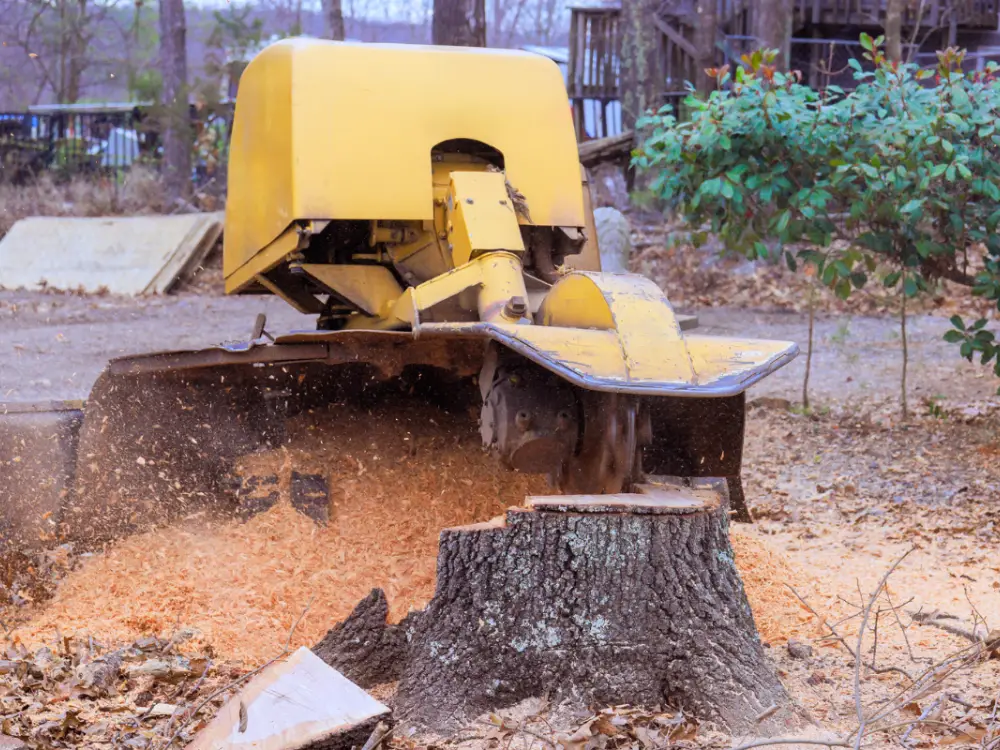
Utility check happens before the grinder starts — underground services are marked before any digging or grinding begins.
On site30–90 min per stump
Depth250mm+ below surface
Mulch can stay or go, your call. We’ll leave the ground-up material for garden use if you want it, or clear it away entirely as part of the visit.
Established property or new-build section — it changes the access
Tauriko runs from a settled rural-edge core to sections still being built out today.
An established Tauriko property’s stumps usually come from tree work done years ago, sitting close to fences, paths, or established garden beds with tighter grinder access. A new-build section sometimes turns up a stump left over from clearing the original block, often on more open ground but with recently laid services underground nearby that need checking first.
Established property
- Tighter access around fences and beds
- More nearby underground services to check
- Established root systems, often wider flare
- Smaller grinder sometimes needed for access
New-build section
- Often more open access for the grinder
- Left over from original site-clearing
- Recently laid services need careful checking
- Ground still settling can hide root depth
We check access and services before the grinder ever leaves the trailer. A tight established section sometimes needs a smaller machine to get to the stump at all.
We check for underground services before grinding near fences, paths, garden beds or recently laid subdivision infrastructure — let us know about any known cabling or pipework on site.
What it costs
Prices start at $95. Fixed once we’ve looked, with green waste already in it — nothing added after.
-
From $95Single stump, under 300mm Standard grind, easy access
-
$140–$220Single stump, 300–600mm Larger diameter
-
$95–$220 eachMultiple stumps Per-stump rate, one visit
-
QuotedLarge stump or difficult access Over 600mm, tight or obstructed access
What moves it
Stump diameterThe main driver of grind time
Root flare widthWide flares need extra passes
AccessTight or obstructed sites take longer
Number of stumpsMultiple stumps on one visit reduce the per-stump cost
We confirm access and check for services before locking in a firm price. Most quotes hold, but a genuinely obstructed site sometimes needs a smaller machine at a different rate.
Stump grinding demand through the year
Fairly steady work, without a strong seasonal pattern.
JanFebMarAprMayJun
JulAugSepOctNovDec
Frequency key
Busier monthsStandard demandQuiet season
Stump grinding doesn’t really follow the seasons. Most jobs come from tree work or site clearing done at any time of year, though autumn and late spring see a small lift as people tidy sections before or after the growing season.
We’d had a stump sitting in the middle of the back lawn for two years after taking a tree out ourselves, sending up suckers the whole time. They checked for services, ground it right down below the surface, and we filled and grassed over it the same week.
What people ask us
Mostly about the job rather than about us, which is how it should be.
01How deep does stump grinding in Tauriko go?
Typically at least 250mm below the surface, which is enough to fill and lay new lawn or planting over the top.
02Will a stump grow back after stump grinding in Tauriko?
No, grinding removes the growth point at the base — any suckers that were already established should stop within a season.
03Does stump grinding in Tauriko check for underground services first?
Yes, always, before any grinding starts near fences, paths or garden beds.
04Is the stump grinding quote in Tauriko the price I pay?
Yes. We agree a fixed price before starting, so the invoice matches the number you were given.
05Is stump grinding different for a leftover stump on a new Tauriko section?
Not really for the grinding itself, though we’ll check carefully for recently laid services before starting on a new-build lot.
06What happens to the hole after stump grinding in Tauriko?
We can fill and level it as part of the visit, or leave it ready for you to fill with topsoil or turf.
07Can stump grinding in Tauriko do multiple stumps in one visit?
Yes, and doing several stumps in one visit usually works out cheaper per stump than separate visits.
08Does stump grinding in Tauriko remove the mulch?
We can either remove it or leave it for you to use in garden beds — your choice.
While we’re there
Most people add one or two of these, since we’re already on the property.
09
Shrubs & Rubbish Removal
Roots out properly, waste sorted into the right stream.
10
Mulching, Bark & Weed Mat
Cuts the weeding on every visit after it.
11
Rental & Section Clean-Ups
Dated before and after photos, itemised invoice.
12
Commercial Grounds Maintenance
Scheduled visits, single point of contact.
01
Lawn Mowing & Edging
Weekly to monthly, edges cut every visit.
02
Ride-On Mowing
For the bigger sections, honest about which ones need it.
View all 12 Tauriko services
Stump Grinding in other areas
