

Anything over about 10 to 15mm starts choking water and nutrients out of the root zone, and it’s rarely visible until you dig a small plug and check.
Lawn Dethatching
Tauriko
Lawn Dethatching in Tauriko
Thatch is the spongy layer of dead grass and root matter that builds up between the soil and the green blades, and once it gets thick enough it starts blocking water and nutrients from reaching the roots. Established Tauriko lawns that have been mown for years without ever being scarified often carry more of it than the surface lets on. Dethatching strips that layer out so the lawn can actually use what you’re feeding it.
- Scarified to the right depth
- Timed for active growth, not dormancy
- All thatch removed, not left on the lawn
- No lock-in contract
Is your lawn spongy underfoot?
A quick description of what you’re seeing helps us gauge the thatch depth.
Fully insured
Scarified to the correct depth
Thatch removed and hauled away
Pause any time
Three things decide how hard a lawn needs scarifying
Thatch builds up differently depending on how the lawn’s been treated.
Runner grasses build thatch quicker than others because they’re constantly laying down new growth at the surface.
Scarifying while the lawn’s actively growing lets it recover fast. Doing it during dormancy just leaves bare, stressed turf.
15mmThatch depth that starts causing problems
2–4wkTypical recovery time after scarifying
From $189Per visit, fixed price
1–2yrRecommended frequency for most lawns
Why a spongy lawn isn’t a healthy one
Thick underfoot feels good until you know what’s causing it.
Under 10mm thatchHealthy, no action needed
Over 15mm thatchRoots starved of water and feed
A small amount of thatch is completely normal and even helps cushion the lawn. Problems start once that layer gets thick enough to act as a barrier rather than a buffer.
Past that point, water runs off instead of soaking in, fertiliser feeds the thatch instead of the roots, and the lawn starts looking thin no matter how well it’s mown.
The only way to actually check is to dig a small plug and look. A lawn can feel fine to walk on and still be carrying enough thatch to be holding growth back — it’s not something you can judge from a distance.
Scarifying pulls that layer out mechanically, and while it looks brutal for a couple of weeks, it’s what lets everything you feed the lawn afterward actually reach the roots.
It looks worse before it looks better. A freshly scarified lawn is meant to look torn up — that’s the thatch coming out, not damage going in.
What a dethatching visit includes
Mechanical scarifying, done to the depth the lawn actually needs.
Check thatch depthA test plug confirms how deep to set the blades.
Mow low firstLawn cut shorter than usual before scarifying.
Scarify the lawnBlades pulled through in overlapping passes.
Clear the debrisAll pulled thatch raked up and removed.
Leave aftercare notesWatering and feeding guidance for recovery.
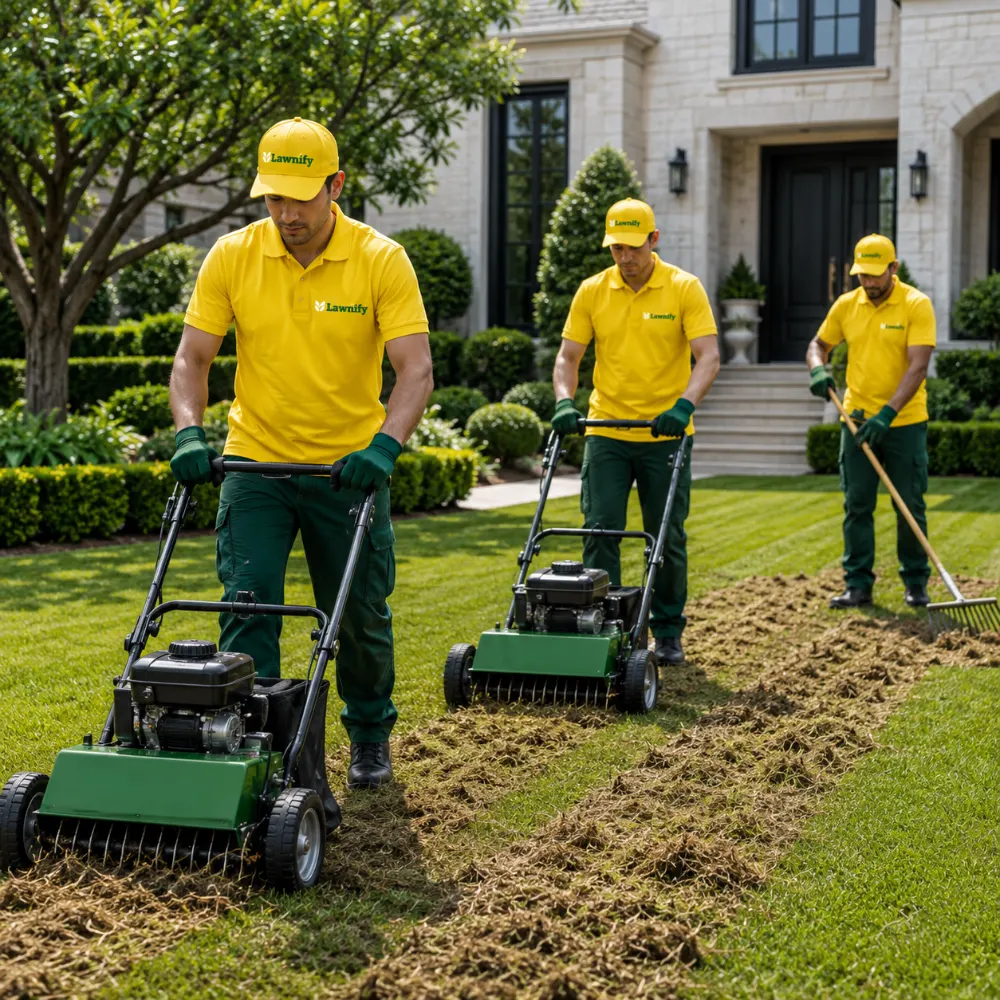
Depth is set to the lawn, not a fixed setting — too shallow does nothing, too deep stresses healthy turf.
On site30–60 min, size dependent
Recovery2–4 weeks to fill back in
All the pulled thatch leaves with us. A scarified lawn produces a surprising amount of debris, and none of it stays behind to smother the recovering grass.
Established property or new-build section — it changes the recovery
Tauriko runs from a settled rural-edge core to sections still being built out today.
An established Tauriko lawn, mown for years without ever being scarified, often carries the deepest thatch layers we come across. A lawn on a new-build section is usually only a season or two old — too young to need scarifying yet, though fast-growing runner grasses can start building thatch faster than people expect once the lawn’s properly established.
Established property
- Deepest thatch layers, longest history
- Usually needs the heavier setting
- Best results over two consecutive years
- Recovery watering into an existing routine
New-build section
- Turf typically too young to need it yet
- Worth checking once the lawn’s 18 months old
- Runner-grass varieties build thatch fastest
- Light first scarify usually all that’s needed
We check age and depth before recommending a scarify. A new-build lawn rarely needs it in the first year or two, whatever the calendar says.
What it costs
Fixed once we’ve looked, starting from $189 per visit. Green waste is already in it.
-
From $95Standard lawn Single scarify pass, debris removed
-
$130–$180Larger lawn Bigger coverage area
-
$150–$220Heavy thatch, first-time scarify Deeper setting, more debris
-
QuotedMultiple lawn areas or slopes Split or awkward-access sections
What moves it
Lawn sizeSets the base coverage cost
Thatch depthHeavier build-up takes longer and more passes
Debris volumeFirst-time scarifies produce the most waste
AccessSplit areas or slopes add time
We check thatch depth before quoting a full scarify. If it’s genuinely light, a lighter treatment or simple aeration might do the job for less.
Dethatching demand through the year
Timed around active growth, not a fixed date.
JanFebMarAprMayJun
JulAugSepOctNovDec
Frequency key
Peak scarify seasonShoulder seasonNot recommended
Autumn and spring do the heavy lifting. Scarifying while the lawn’s actively growing means it recovers within weeks — doing it in the middle of a hot, dry summer just adds stress on top of stress.
Our lawn had been mown for probably fifteen years and never once scarified — it felt springy but never looked right. They pulled out bags of thatch, it looked terrible for two weeks, and then it came back thicker than we’d seen it in years.
What people ask us
Mostly about the job rather than about us, which is how it should be.
01Will scarifying during lawn dethatching in Tauriko damage my lawn?
It looks harsh for a couple of weeks but it’s a standard, necessary process — the lawn recovers stronger once the thatch layer is gone.
02How do I know if my Tauriko lawn needs lawn dethatching?
A spongy or bouncy feel underfoot, or water pooling instead of soaking in, are the main signs. We’ll check with a test plug on site.
03How often does a Tauriko lawn need lawn dethatching?
Most established lawns benefit from scarifying every one to two years, depending on turf type and growth rate.
04How much does lawn dethatching in Tauriko cost?
Most Tauriko lawns start from around $189 a visit. The exact price depends on lawn size, turf type and how compacted the thatch is.
05Does a young Tauriko new-build lawn need lawn dethatching yet?
Usually not. New turf rarely carries enough thatch to need scarifying until it’s well established — we’ll check before recommending it.
06Should I aerate as well as lawn dethatching in Tauriko?
Aeration and dethatching solve different problems and work well done together, though not always in the same visit.
07What do I do with my Tauriko lawn after lawn dethatching?
Water it regularly for the first few weeks and hold off on heavy foot traffic while it fills back in.
08Can lawn dethatching in Tauriko be combined with regular mowing?
Yes, we’ll schedule the scarify visit alongside your regular mowing plan if you have one.
While we’re there
Most people add one or two of these, since we’re already on the property.
05
New Lawn Install
Ready lawn or seed, prepped properly either way.
06
Garden Maintenance
Beds kept ahead of the season, waste off site the same day.
07
Tree & Hedge Trimming
Shape and species checked before a blade goes near it.
08
Stump Grinding
Ground below the surface so you can mow straight over it.
09
Shrubs & Rubbish Removal
Roots out properly, waste sorted into the right stream.
10
Mulching, Bark & Weed Mat
Cuts the weeding on every visit after it.
View all 12 Tauriko services
Lawn Dethatching in other areas
