

A retail frontage is judged on what a customer sees from the footpath. A body corporate is judged on whether every owner’s shared patch looks the same as the next. A small commercial site is judged on nothing going wrong. The same crew and the same gear, scoped three different ways.
Commercial Grounds Maintenance
Ōhauiti
Commercial Grounds Maintenance in Ōhauiti
We hold grounds contracts across Ōhauiti — the retail frontages along Ōhauiti Road, body corporate grounds on the newer terraces up the hill, small commercial sites out towards Kaitemako Road. Every one of them runs off a written scope and a set visit day, because the thing that goes wrong with grounds care is never the mowing. It is a task quietly dropping off a list nobody wrote down.
- A set visit day, not a rough week
- One person on the account, not a queue
- Written scope you can point at
- Police-vetted crew on site
Grounds contract quote
Site type and rough frequency is enough to start scoping it.
Police-vetted team
Same crew, same standard each visit
Written scope of works
Contract revisited each year
Three things decide how an Ōhauiti grounds contract gets scoped
A commercial site needs a written scope. A rough understanding is what you have until the first thing gets missed.
Weekly, fortnightly or monthly — settled before the contract starts, against the growth rate and the standard you need held. What we do not do is quietly stretch the interval in a slow month and hope nobody counts.
Every area that gets mown, every edge that gets cut, every bed that gets weeded, listed. So when a committee member asks in eighteen months whether the carpark island was ever in the deal, there is a document that answers it instead of two people remembering differently.
100+customersHappy customers across the Bay
30+jobsJobs completed around Tauranga
From $75Per visit, fixed programme
1contactOne person on your account
Why an Ōhauiti grounds scope has to be on paper
A verbal arrangement holds up fine for months, and then one week it stops holding up.
Informal, ad hoc arrangementScope drifts, standards slip
Written contract and scheduleConsistent standard, accountable
Informal arrangements rarely fail suddenly. They drift. A visit slides a week, a corner stops getting edged, a bed stops getting weeded, and six months later the grounds look tired and nobody can say precisely when it started or what was supposed to be happening.
A written scope removes the argument before it exists. What is included, how often, to what standard — on paper, in your hands, before the first visit.
On a shared site that matters far more than it does on a private lawn. Committees turn over. Managing agents turn over. A document outlives both of them; what nobody can hand on is their own memory of a chat in a car park.
The scope is revisited each year so it can move with the site — planting matures, a car park gets resealed, a tenancy changes — without anybody starting from a blank page.
A scope on paper is the difference between a contractor you have to supervise and one you do not. It also means you can hold us to it, which is rather the point of writing it down.
What an Ōhauiti commercial grounds visit includes
Five steps, the same five, on a day you can put in a diary.
Turn up on the agreed dayA set day, not a rough week. If weather moves it, you are told it has moved.
Work the document, not the eyeMowing, edging, trimming and bed work exactly as the scope lists it, including the bits nobody would notice.
Extra time at the entranceFrontages and entranceways get the detail, because that is the part people form an opinion from.
Take the waste with usClippings and rubbish leave on the trailer. Nothing is bagged up behind a bin store for somebody on site to deal with.
Tell you what we foundA failed irrigation head, a cracked kerb, vandalism — passed to your named contact instead of waiting for somebody on site to spot it.
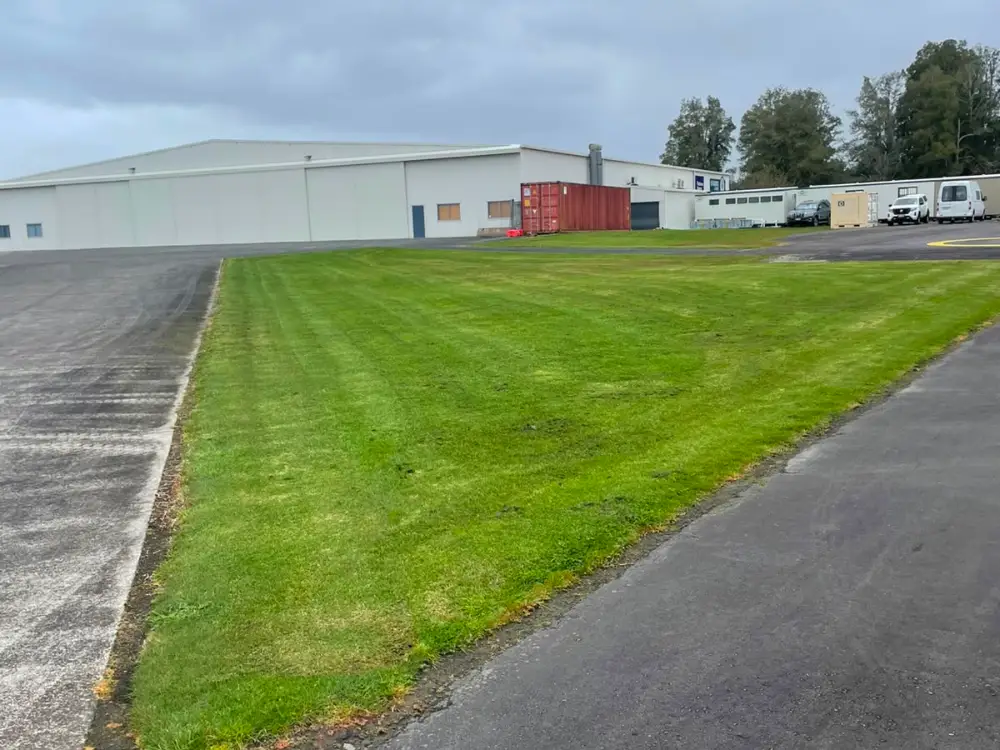
Every visit follows the written scope — the same tasks, to the same standard, on the same schedule.
ReportingStraight to your one contact
The same crew keeps the same site wherever we can manage it. A crew that knows where the outside tap is, which gate needs lifting and which planting the owners actually look at gets more done inside the same hour — and misses less of it.
Established Ōhauiti site or new-build — two different grounds plans
This suburb runs from settled commercial pockets to hillside subdivisions still being finished.
A settled site around the Ōhauiti Road shops has turf that has been there for years and a growth pattern you can predict a season ahead. A shared-grounds site on the newer hillside terraces is a different proposition: turf laid last winter, young planting around retaining walls and shared driveways, and drainage that has not yet been through a proper wet August. The first of those is a maintenance job. The second is closer to nursing something through its first year.
Established site
- Turf and beds that have found their rhythm
- Growth you can predict a season out
- A mowing and trim interval that does not need revisiting
- The same presentation standard in February as in July
New-build development
- Turf still rooting, and easy to damage with the wrong cut
- Young planting that wants watching rather than trimming
- Retaining walls and drainage worth a look before the first wet month
- A scope written to loosen off as the beds fill in
The scope gets written to the site in front of us, not to a template. A shared-grounds development finished eight months ago and a commercial frontage that has been there fifteen years should not be carrying the same plan in their first year together, and if somebody quotes you as though they should, that is worth a question.
What Ōhauiti commercial grounds maintenance costs
Programmes open at $75 a visit, disposal counted in, and the number settled once the site has been walked.
-
QuotedSmall site, monthly Mown, edged, waste away, from $75 a visit
-
QuotedRetail frontage, fortnightly Presentation-focused schedule
-
QuotedBody corporate, weekly Shared grounds, full scope
-
QuotedSeveral sites, one contract One scope, one schedule, one invoice
What moves it
How much groundSets the base hours in every visit
How oftenA weekly round costs less per visit than a monthly one
What is in the scopeA frontage judged on detail takes longer than a back lawn
How many sitesSeveral on one schedule beat the same sites booked apart
Nobody gets a commercial figure over the phone. Two sites of identical area can be an hour apart in practice once you have counted the edges, the beds and the bits a mower cannot reach, so somebody walks it first and the number comes after that.
The Ōhauiti grounds year, visit by visit
The schedule does not move. What moves is how much work is waiting inside each visit.
JanFebMarAprMayJun
JulAugSepOctNovDec
Frequency key
Heavier visits — Mar to May, Sep to OctStandard visits — the rest of the yearSchedule unchanged throughout
This is the argument for a fixed programme rather than calling someone when it looks bad. The visit that costs us most is the one in October, and it costs you the same as the one in July. Price a year of it against a year of ringing round for one-off tidies and the contract wins comfortably.
The scope we write is the scope we can be held to, and that cuts both ways. If a committee asks whether the carpark islands were in the deal, the document answers it — and if the answer is no, we say no and quote to add them rather than quietly absorbing the work and then quietly dropping it again six months later. A scope that only protects the contractor is not a scope, it is a brochure.
Ōhauiti commercial grounds questions
The eight that come up on almost every site walk-through we do out here.
01Do you hold commercial grounds contracts for Ōhauiti body corporates?
Yes — shared-grounds work makes up a large share of what we do in this suburb, and the hillside developments account for most of it. One scope covering every shared area, one visit day, one contact, and an invoice the committee can reconcile without ringing anybody.
02How is commercial grounds maintenance in Ōhauiti priced?
The opening rate is $75 a visit, and where you land above it is settled once somebody has measured the ground. Area, visit frequency and the detail written into the scope all move it, and two sites measuring the same on paper can sit an hour apart once the edges, beds and awkward corners are counted. That is the reason there is no phone quote for commercial work.
03Can an Ōhauiti grounds scope be changed after the contract starts?
Yes. There is a scheduled look at it every year, and anything that cannot wait is handled in between — a new tenant, a resurfaced forecourt, a bed pulled out and replanted. What does not happen is work quietly appearing or quietly disappearing without the document changing to match.
04What does a weekly grounds contract cost on an Ōhauiti retail frontage?
More per month than a monthly round and less per visit, which is the trade on every frequency. A frontage judged on presentation generally wants fortnightly or weekly through the growing season, and the per-visit rate comes down as the interval shortens because the crew is never fighting three weeks of growth. The starting figure is $75 a visit and the scope decides where above that you land.
05Our Ōhauiti site is a new hillside development — does that change the grounds contract?
It changes the first year of it. New turf takes damage from a cut that an established lawn would shrug off, and young planting wants observing more than it wants cutting, so the early scope goes gentle on the lawn and light on the beds, with a look at the retaining walls and the drainage before the first heavy month of rain. The document is written to relax as the planting thickens up.
06Does an Ōhauiti commercial account get one point of contact?
One person, named, who knows your site. Not a general inbox and not whoever happens to answer. On a body corporate that matters more than it sounds, because the person chasing us is often a volunteer committee member doing it around a job of their own.
07What happens when the crew finds damage on an Ōhauiti grounds visit?
It gets reported to your contact rather than left for you to notice. A head that has stopped spraying, a kerb that has split, a young tree snapped off at the stake, paint on a retaining wall — we are in front of all of it weekly and you might not be for a month. Nothing outside the scope gets repaired without asking first, but you will never be the last to hear about it.
08Can several Ōhauiti sites run under one grounds maintenance contract?
Yes, and it is usually cheaper than the same sites booked separately, because the crew moves between them in one run rather than making a trip for each. One scope document with each address itemised inside it, one schedule, one invoice — and the per-site figure comes down as the round gets tighter.
Other Ōhauiti work for the same visit
Added onto a scheduled contract visit, each of these costs less than it would as a call-out of its own.
01
Lawn Mowing & Edging
Weekly to monthly, edges cut every visit.
02
Ride-On Mowing
For the bigger sections, honest about which ones need it.
03
Weed Control & Fertilisation
Calibrated to your soil, not a one-size feed.
04
Lawn Dethatching
For lawns carrying years of thatch build-up.
05
New Lawn Install
Ready lawn or seed, prepped properly either way.
06
Garden Maintenance
Beds kept ahead of the season, and the waste leaves with us.
