The weeds get identified
Onehunga weed, clover, dandelion and oxalis all take different products. Spraying the wrong one is how people end up spraying three times.

From the coastal sand at Papamoa to the orchard ground around Te Puke, we run lawn weed control and fertilisation right through the region — broadleaf weeds knocked out selectively, then a feed matched to the season rather than whatever was in the shed.
Where the lawn is, and what is growing in it.
Most of the result comes from picking the right product and the right week, which is the part a shed bag cannot do.
Onehunga weed, clover, dandelion and oxalis all take different products. Spraying the wrong one is how people end up spraying three times.
The product goes after the broadleaf and leaves the grass standing. A blanket knockdown kills everything and leaves you with bare dirt.
Nitrogen-heavy going into the growing months, a different blend heading into the cold. One bag used all year is why lawns look good in spring and tired by February.
Treatments sit far enough apart for the last one to finish and close enough that the weeds never get a run at it.
Pets and kids stay off until the lawn has dried, usually a few hours. The crew gives you the actual time before they go.
What went on, at what rate, and when the next one is due. Useful if anyone ever asks what has been applied.
Some of these want spray, some want feed, and one of them wants neither. Knowing which is most of the job.
It spreads sideways and crowds the grass out. It also means the lawn is short on nitrogen, so the feed matters as much as the spray.
The obvious ones. They pull out easily by hand and come straight back, because the taproot stays in the ground.
The one that ends barefoot summers. It has to be treated in winter or early spring, well before the prickles form.
Usually damp and shade rather than a weed problem. Worth saying so, because spraying it does not stop it coming back.
Yellowing, slow growth and weeds filling the gaps is a lawn that is simply hungry. Feed often fixes more than spray does.
Young grass gets out-competed easily, and most weed products cannot go on until it has established. Timing is the whole thing.
Lawn feels spongy or sheds water? That is a thatch layer rather than a weed or a feeding problem, and dethatching is the fix. We will tell you which one you have got.
Treatments start at $85 each. What moves that figure:
A close-up of the weeds, plus the address.
Then priced on the product the lawn needs.
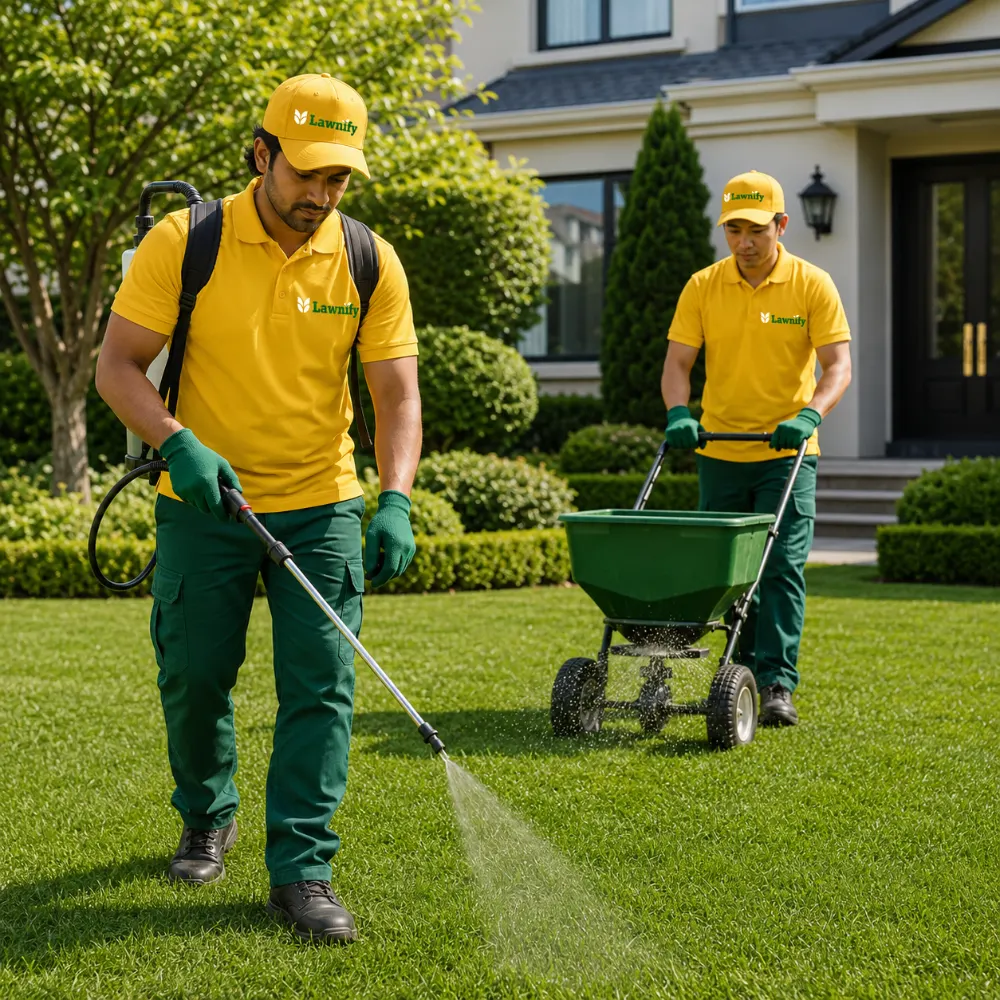
Selective spray on the weeds, feed on the grass.
Spaced treatments keep the weeds from coming back.
Retail weed and feed is one product sold to the whole country. It is deliberately mild, because it has to be safe in the hands of someone who will not read the label. That is why it rarely finishes the job.
Stronger than the retail bag and measured to the square metre. Most home-applied failures are an under-dose, and most burnt lawns are an over-dose.
Onehunga weed and oxalis do not answer to the same thing. Identifying before spraying is the difference between one treatment and three.
A programme written for a Canterbury season is wrong by about six weeks here. Ours moves with what the lawn is actually doing.
There is a page per town below. If yours is missing the address is still worth sending. Our full list of services sits on the Bay of Plenty page.
Four local things decide when a treatment goes on and which product it is.
The creeping lawn types that do well in this climate grow hard and use nutrient fast, so they want feeding more often than a cool-climate lawn.
The same warm months that grow the lawn grow everything else. Miss the window in late spring and you are chasing it until autumn.
Coastal ground at Papamoa and the Mount drains so freely that nutrient leaches out. Lighter, more frequent feeding beats one heavy application there.
Overfeeding a humid lawn invites disease. When conditions are right for it we ease the nitrogen back rather than push growth the lawn cannot support.
Mostly about how fast it works and whether the dog can go back out.
It starts at $85 per treatment. The figure moves with the area being treated, how established the weeds are, whether you want a seasonal programme or a single hit, and whether anything growing needs a specialist product.
A selective spray works through the plant rather than burning it, so expect curling within days and die-back over a fortnight or so. Anything that shrivels the same afternoon has usually taken the grass with it.
Once it has dried, yes. Keep everyone off while the lawn is still wet, which is normally a few hours depending on the weather. The crew confirms it before they leave.
A lawn in reasonable shape settles onto a seasonal rhythm. One that has been let go needs a heavier opening treatment and a follow-up before it gets there. We say which yours is once we have seen it.
Yes, and plenty of people start that way. A one-off costs more per treatment because the lawn has slipped back to the beginning each time you call.
You can, and on a lightly weedy lawn it helps. Retail product is deliberately mild and sold one-size-fits-all, so on a lawn that has got away it tends to knock the weeds back without finishing them.
Not on its own. Moss is usually damp and shade, and bare ground needs grass put into it. If the real problem is a thatch layer, that is dethatching and we will say so.
Leave the lawn a few days either side if you can. The weeds need leaf area to take the product up, and the feed wants a chance to water in before it gets cut off.
Yes. Everyone handling product on a customer’s lawn is vetted before they start, and we can confirm that in writing if you want it.
Harbour side we treat Bethlehem, Matua, Otumoetai and Tauranga. East of there, Ohauiti, Welcome Bay, Mount Maunganui and Papamoa. West and inland, Omokoroa, Te Puna, Te Puke, Pyes Pa and Tauriko. Elsewhere, ask.
A lawn treatment programme pays off fastest on grass that is already being cut properly, so weed and feed is usually booked with regular lawn mowing and, where thatch is blocking the feed, a lawn dethatch.
Send the address and a close-up of what is growing. We identify it, then price the treatment.
