Weekly Premium Care
From$35per visit
For a lawn that always stands out.
- Mowing every week
- Edges and borders trimmed
- Paths and driveways blown clean

A lawn that looks good in Matua is almost always one that gets cut properly. Lawn mowing comes down to three things: the right height, before it has run away, with a blade that slices rather than tears. We mow and edge sections from the sheltered streets around Fergusson Park out to the open frontage on Beach Road, and the round moves with the season so nothing is left long enough to need rescuing.
From $35a visit
The figure you agree is the figure on the invoice. Nothing gets added once we have been.
Your street, and roughly how much lawn there is to cut.
Lawn mowing plans in Matua
Choose how often your lawn gets mowed in Matua. We’ll take care of the rest.
From$35per visit
For a lawn that always stands out.
From$45per visit
Keep your lawn tidy and well maintained.
From$55per visit
Basic upkeep for slower-growing lawns.
Starting prices per visit. Final quotes depend on lawn size, access and grass condition. Overgrown lawns and clipping removal may cost extra.
Send us your property address for a free, tailored quote.
None of them costs a cent. Get lawn mowing right in Matua and most of what owners later pay to fix never starts.
Taller than most people run their mower. The leaf is what shades the soil underneath it, so a lawn kept at that height carries its own moisture through a dry Matua week rather than waiting on a sprinkler to make up the difference.
Cut past a third of the blade and you go through the green into pale stem with no chlorophyll in it. That is the reason a lawn turns yellow after a cut, and it has nothing to do with the machine that did it.
A torn leaf tip frays, goes pale inside a day and bleeds moisture far faster than a clean cut ever does. Ours go on the grinder to a schedule, not once somebody notices they have gone off.
The arithmetic nobody runs through with you before taking the booking.
A lawn banks its energy in the leaf, which is why how much comes off matters more than how often somebody turns up. At a third, the plant barely registers the loss, and the clippings land fine enough to drop back and disappear into the soil the same afternoon.
Take half or more and you have removed most of its working surface. It stops spreading outward and spends a fortnight rebuilding what it lost. That is the entire explanation for why a hard cut yellows a lawn and a light one does not.
Repeat it and the cost compounds. What the plant sheds while rebuilding does not go anywhere; it settles as a felted band between the green and the soil. On an older Matua section that has run the same long-gap routine for decades, that band is usually thicker than the owner has any idea of.
So a lawn left a month and then scalped has not saved you a visit. It has bought a bigger job later, at a price nobody quoted you.
Twenty minutes to an hour of lawn mowing and edging on most sections, and nobody needs to be home for any of it.
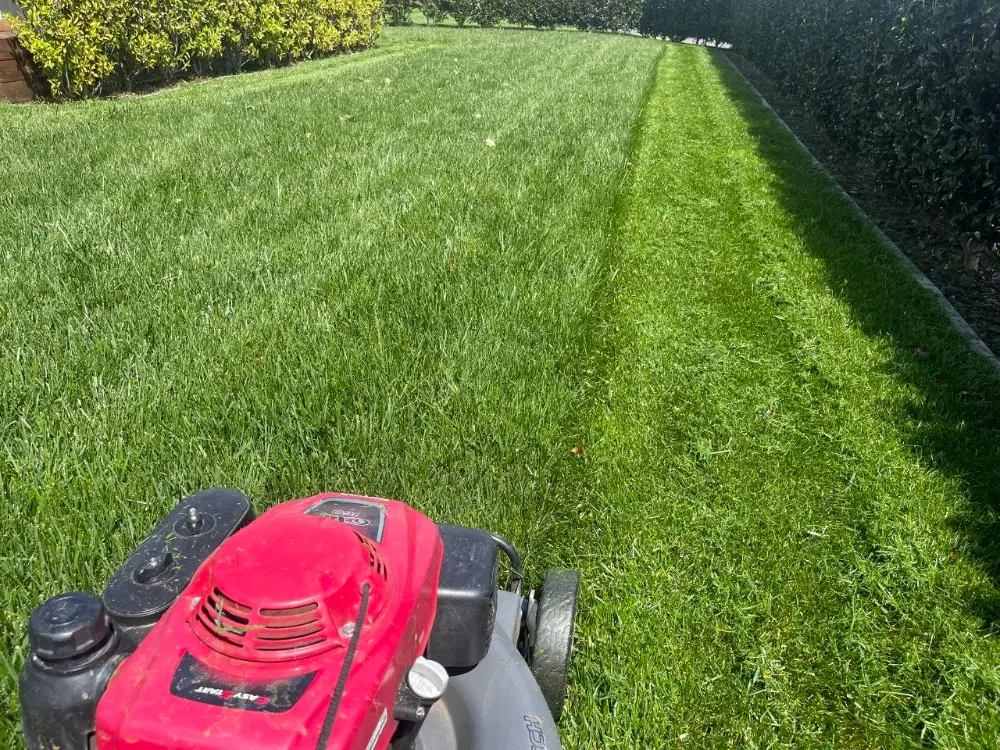
The same five steps in the same order — on a sheltered inland section and on an exposed one out by the water alike.
Clippings stay on the lawn unless there are too many of them. Cut fine and cut often, they are gone within hours and feed the soil for nothing. When there is more than the lawn can swallow — a first cut on something overgrown, say — the catcher goes on and they leave with us, at no change to the figure you agreed.
The one local thing worth knowing, and it moves the round rather than the price.
Matua sits out on the Ōtūmoetai peninsula and it is a settled suburb rather than a new one — most sections here have carried the same lawn for forty years or more. The shape of the peninsula puts two different jobs side by side, though. There are the sheltered streets inland around Levers Road and Fergusson Park, and there is the frontage along Beach Road where wind and salt air off Tauranga Harbour genuinely change how the grass grows.
Give us your street when you enquire. A sheltered section and an exposed one are not quite the same job, and knowing which one you have changes how we set the mower — rarely what we charge for it.
Starts at $35 and gets fixed once we have looked. Carting the green waste away is already inside that.
A mature garden takes longer, not a different bracket. Working carefully around established borders adds minutes to the visit, and the quote reflects those minutes rather than jumping you up a tier for having a nice garden.
Visits close up and spread out on their own. The rate stays exactly where it was.
Harbour wind slows the drying, not the growing. A lawn a street back from the water can sit wet for longer after rain than one a few streets further in, which is why the round shifts by street as much as by month — and why we would rather move your day than mow a soaked lawn.
If the gap you are asking for is going to cost you more over a year, you will hear that before you book rather than after. Putting a Matua section on a monthly round through December pays us exactly the same and hands you a lawn we have to rescue in February, so we would sooner have the argument about frequency now.
The eight we field most often standing on a Matua front lawn.
Weekly from roughly November through January, fortnightly through the shoulder months, and about once a month once winter is properly in. Growth slows in the cold rather than stopping, so a long winter gap usually hands you an uneven, matted lawn to sort out in spring.
No. As long as the lawn can be reached, nobody has to be there. A photo goes through once the visit is finished, so you can see the state the section was left in from wherever you are.
The visit moves. A mower on saturated ground tears at the grass and leaves ruts behind, so we push to the next workable day and tell you it has shifted. A visit that did not happen never turns up on an invoice.
No minimum term and no cancellation fee — a text is enough to pause or to stop altogether. Plenty of Matua customers pause over winter and pick up again in spring, though the cut you come back to is always the bigger one.
Higher than most people run it — the mid-thirties to mid-forties in millimetres once summer is properly up. The point of it is shade: a longer leaf keeps the sun off its own root zone, so the lawn stops needing a sprinkler to get through a dry fortnight.
Sometimes. Wind and salt air off the harbour toughen the leaf and slow how fast the ground dries after rain, which can move the frequency a notch either way. We set the height off what is actually growing on your section, not off the street name.
Too much is coming off in a single pass. Once the mower goes beyond a third of the leaf it is cutting the pale part of the stem, where there is nothing green left, and that is what you are looking at for the following week. It is nearly always the gap between cuts, not the machine.
More than people expect. A sharp edge slices the leaf; a blunt one tears it, and a torn tip loses moisture and gives disease an opening. Ours come off and get sharpened on a set interval, not on the day somebody finally notices.
Most people pick up one or two of these, since the trailer is already on the verge.
