
Beds stripped back first
Weeds pulled at the root and the surface levelled. Laying mat over live weed just gives them something to grow through.

Mulching, bark and weed mat for Bay of Plenty gardens, from beachside beds at Mount Maunganui to new-build sections out at Tauriko. Beds cleared, mat overlapped and pinned, then bark laid deep enough to actually stop the weeds coming back.
Where the beds are, and roughly how much there is.
Weed mat either lasts years or fails in one season, and the difference is entirely in these six steps.
Weeds pulled at the root and the surface levelled. Laying mat over live weed just gives them something to grow through.
Sheets lap over each other by a good margin. Weeds find a straight seam within a season, which is why most DIY mat fails at the joins.
Pegged at the edges and through the middle so it cannot lift, ride up under the bark or show through after the first good wind.
Thin enough to see soil through and it suppresses nothing. We lay to a depth that actually blocks light, which is the whole mechanism.
Neat openings around each shrub rather than mat jammed up against the stems, so the plants you want keep breathing.
Bark, mulch or chip delivered and barrowed in. You are not left arranging a trailer or shifting it up the drive yourself.
Worth doing in some beds and a waste in others. These are the ones where it pays for itself.
Settled planting you are not going to move. The best case for mat, because nothing gets disturbed once it is down.
Bare ground between young plants is where weeds take hold first. Mat and bark buys the planting a few years to fill out.
A ring of mulch keeps the mower and line trimmer off the trunk, which is what damages young trees more than anything.
Mulch on a slope slows runoff and stops the soil washing down the bank every time it rains hard.
The strips nobody wants to weed. Mat and bark there removes a recurring job rather than a one-off tidy.
Mulch suits natives, which like the cool damp soil underneath and are usually planted to be left alone.
Beds too far gone to mulch straight over? They get cleared first, or booked as a garden maintenance catch-up and mulched once there is a bed worth protecting.
A job starts at $149, material, delivery and spreading all in. Four things set where yours lands:
Length and width of the beds, plus the address.
On site, then a fixed price with material in it.
All in one visit, with the waste taken away.
After that the beds mostly look after themselves.
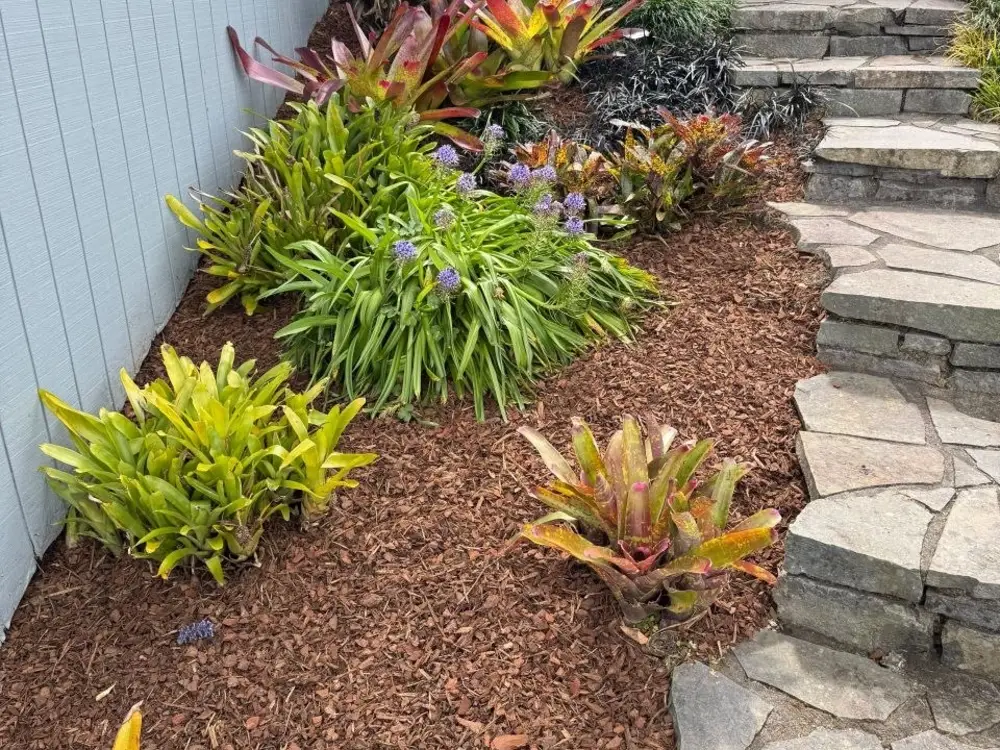
Nearly everyone who says weed mat does not work has seen a job where the sheets were butted edge to edge, the pins were skipped, or the bark went on too thin. The product is rarely the problem.
Weeds do not come through woven mat, they come through the gap between two sheets. A generous overlap is cheap and it is the whole difference.
Bark suppresses weeds by blocking light. A thin scatter looks the same on day one and does nothing by spring, which is why we lay to a measured depth.
Mat under a perennial border you keep replanting is a nuisance, not a help. We will say when bark alone is the better answer.
A page per town below. Bark travels, so a town that is not listed is usually still doable — worth asking. The rest of what we do sits on the Bay of Plenty page.
Warm and damp is hard on organic mulch and generous to weeds. Four things worth knowing before you choose a material.
Warm and damp rots bark faster than a cooler region would. That feeds the soil, which is good, but it means a top-up every few seasons rather than laying once and forgetting it.
Growth runs most of the year here, so bare soil does not stay bare for long. Coverage with no gaps matters more than it would further south.
Coastal beds at Papamoa and the Mount dry out fast, so mulch earns its keep holding water in. The heavier ground inland holds it anyway, so there the job is mostly about weeds.
Going on before the spring flush gives the beds their longest clean run. Laying in midsummer still works, there is just more to clear out first.
Mostly whether weed mat is worth it, and how deep the bark has to go.
Jobs start at $149 with the material, delivery and spreading included. Square metres of bed is the main driver, then which material you pick, how much clearing is needed first and how far the bark has to be barrowed.
Woven mat does, for years, when the sheets overlap generously and it is pinned. Almost every failure people describe is weeds coming up through a butted seam or a corner that lifted, not through the fabric.
Bark holds its look longer and suits beds you want tidy. Mulch breaks down faster and feeds the soil, which suits productive or native planting. We will tell you which fits what you are growing.
Deep enough that no light reaches the soil. A thin scatter looks right the day it goes down and has stopped working by spring, which is the single most common reason people think mulch failed.
Organic material rots down faster in this climate than a cooler one, so the bark wants refreshing periodically rather than laid once. The mat underneath outlasts it by years.
Yes. Mat gets cut in around each shrub rather than jammed against the stems, and bark is kept back off the trunks. Piling it up against a stem is how you rot one.
No, and we will say so. For a border you replant every season it is more nuisance than help, and bark on its own does the job without you cutting mat open each time.
Not really. You cut a cross in the mat, plant through it and fold it back. It is a minute of extra work rather than a barrier.
Whatever comes out of the bed goes on the trailer. You are not left with a pile of old bark and weeds at the end of the drive.
Tauranga, Otumoetai, Matua and Bethlehem around the harbour. Papamoa, Mount Maunganui, Welcome Bay and Ohauiti to the east. Te Puke, Te Puna, Omokoroa, Pyes Pa and Tauriko inland and west. Anywhere else, just ask.
Bark lasts longest on garden beds whose planting is kept up, so this job is often paired with a garden maintenance round, and with shrub and rubbish removal when a bed has to be emptied first.
Send the address and rough bed sizes. Material, delivery and spreading are all in the number.
